Showing posts with label sci-fi. Show all posts

Friday, 26 September 2014

'The Departure' - Neal Asher (Tor UK)

The Argus Space Station looks down on a nightmarish Earth. And from this safe distance, the Committee enforces its despotic rule. There are too many people and too few resources, and they need twelve billion to die before Earth can be stabilised. So corruption is rife, people starve, and the poor are policed by mechanised overseers and identity-reader guns. Citizens already fear the brutal Inspectorate with its pain inducers. But to reach its goals, the Committee will unleash satellite laser weaponry, taking carnage to a new level.
This is the world Alan Saul wakes to, travelling in a crate destined for the Calais incinerator. How he got there he doesn’t know, but he remembers pain and his tormentor’s face. He also has company: Janus, a rogue intelligence inhabiting forbidden hardware in his skull. As Janus shows Saul an Earth stripped of hope, he resolves to annihilate the Committee and their regime. Once he’s discovered who he was, and killed his interrogator . . .

Neal Asher is one of those authors where I really feel like I should have read more of his books than I actually have done (three or four so far, in case you're wondering). I have a natural aversion to long running science fiction series if I haven't been reading them from the start, too much time and investment required, and this is the case with Asher's 'Polity' works. (Apropos of nothing, I have absolutely no qualms diving into long running fantasy series; that's how I roll).
A bit of birthday money and what looks like a completed trilogy ('The Owner' trilogy) looked like a great way to address this, I've been in the mood for a little space opera just recently, so I did the only thing I could. I started reading :o)

'The Owner' books are a 'departure' (pun not intended originally but I'm running with it) from Asher's 'Polity' books, taking place on an Earth reminiscent of 'Blake's 7' with a totalitarian government stamping down hard on the general populace. I couldn't help but wonder if Asher's politics were showing a little too clearly in the plot (with some of the background prose perhaps being a little too opinionated in terms of the actions of government) but the overall affect is compelling with Asher killing off vast swathes of humanity with almost gleeful abandon (in marked contrast to the chilling statistics delivered by an increasingly impersonal Alan Saul) using weaponry apt for such a vicious regime. The Shepherds make me shiver a little just writing about them. There is a lot of scope here for full on 'sci-fi violence' and Asher makes the most of every chance he gets. The body count is astronomical although the heavy numbers all happen 'off the page' as it were. What you do see though is hard hitting enough. No-one is safe from the guns of the Committee or Saul's robot army. Certain characters are guaranteed to make it through but don't get too attached to any of the supporting cast, that's all I'm saying…

A key theme of 'The Departure' is Saul's transition from man into a post-human man/machine hybrid. For the most part Asher handles this transition very well with some interesting insights into just what it means to gradually surrender your humanity. Saul's conflict with Director Smith is also a high point as far as this theme goes with Asher showing the fight on two fronts with blows dealt in cyberspace and some stunning sequences taking place between opposing armies of robots on a space station (worth the price of entry). Metal stuff gets blown up and/or ripped to pieces by other metal stuff and there are times when you can't ask for much more than that. Where Asher fell down for me, exploring this theme, was that there were times where he made Saul a little too impersonal. I can understand the approach but some of the resulting descriptive passages came across as rather dull, I'm thinking of Saul's view of the Argus space station which I ended up skimming just to get to the good bits.

On the whole, 'The Departure' is a fast paced affair with a mix of big explosions, an 'evil empire' and a flawed anti-hero; more than enough to make me want to read the next book in the series. Having said all that though, 'The Departure' is also a book that can feel like it's talking in a monotone at the most inappropriate times; I'm hoping for good things from 'Zero Point' but will approach it with some caution...

Wednesday, 10 September 2014

'Doctor Who And The Image Of The Fendhal' - Terrance Dicks (Target)

 If there is anything that looks more dated than old Doctor Who cover art I have yet to see it...  :o)

A sonic time scan draws the TARDIS to the Fetch Priory on Earth. There, the Doctor and Leela discover an impossibly old human skull that is the key to a nightmare from the Time Lords’ past.
A murderous monster stalks the priory grounds; and within, someone is intent on unleashing a malevolent creature that feeds on death itself... 

I think this is likely to be the last 'Doctor Who' book (well, Target novelisation) spoken about here for a very long time. I've done enough comfort reading around Doctor Who anyway and there's also the inescapable fact that the more of these books I talk about, the less I have to say. They all follow the same lines structurally and thematically which doesn't leave you a lot else to talk about. One day, I'm considering copying an old review (just swapping the title for something different) and seeing if anyone notices… ;o)

But in the meantime, 'The Image of the Fendhal'. If 'The Curse of Fenric' was the story that scared me as a teenager then 'The Image of the Fendhal' is very much the book that scared the life out of me as a child. The opening scenes, which cut between an experiment that takes an unexpected turn and the resulting death of a hitch hiker build up tension very nicely to a well placed climactic scene which pushes you headlong into the rest of the plot. 

'The Image of the Fendhal' is another Doctor Who story simply told and very formulaic. You certainly get what you pay for here (in this case, a penny via Amazon New and Used…) Making up for this though is a really dark undertone of horror that props the story up. When even the Doctor is scared of the Fendhal you know that they are an enemy who will take some defeating. And you really feel the rising terror in the characters when they find their legs refusing to move as the Fendhaleen bears down on them… It's moments like this that make the story worth reading and I wouldn't mind tracking down the DVD to see how the story comes across on screen. 'The Image of the Fendhal' is a simple tale but also a dark one that taps into Doctor Who in a way that I don't normally find with the TV show. Are all Fourth Doctor stories like this (I seem to remember reading a few like this as a kid)?

I'm not sure I'll be in a mad hurry to re-read 'The Image of the Fendhal' (nostalgia will only take you so far after all) but it was fun while it lasted and still had the capacity to make the hairs on my arms stand up. Can't ask for a lot more than that really.

Saturday, 30 August 2014

'Doctor Who and the Stones of Blood' - Terrance Dicks (Target)

Searching for the third segment to the Key to Time brings the Doctor and Romana to present-day Earth, where the travellers have to contend with stone circles, Druidic rituals and a not-so-mythical goddess known as the Cailleach. 

Unsurprisingly at the moment, it's all about comfort reading for me right now (which explains why it has taken me weeks to get to where I am with A.J. Smith's 'The Black Guard' but more on that another time…) and it struck me how the term doesn't quite gel with a lot of genre fiction. For example, last night I was after a comfort read and, at one point, it came down to a choice between 'A Game of Thrones' and 'The Stand'… I guess 'comfort reading', in this case, is more about familiar settings and
characters rather than the story itself and that's why you're looking at another Doctor Who post today :o) The Target novelizations are all about
comfort reading for me; familiar stories that I either read or saw on the TV, all wrapped up in cosy memories of cheese on toast for tea and lunchtime trips to the mobile library that used to park outside the shopping centre. And where is that shopping centre now, eh? It’s the foundations of an Asda, that's where it is. But anyway…

I never saw 'The Stones of Blood' on TV but borrowed it from the library, as a kid, and was scared by it just enough to make me pick up a copy again from the local comic book store (which is incredibly well stocked on Doctor Who books, I sense the possibility of another collection starting up…) and see what how the intervening years had treated it. These days, a Doctor Who book is normally good for a bus ride to work and back and 'The Stones of Blood' proved no different in this regard. It still had the power to scare as well, mostly through what is implied rather than what you actually see happen. The note of fear in De Vries' voice, coupled with the keen timing of the Ogri attack, makes for a nerve wracking passage and there are more of these interspersed throughout the book.

I'm at the point now, with the Target novelizations, where it almost goes without saying that 'The Stones of Blood' is, for the most part, a 'by the numbers' retelling of what viewers would have seen on the TV. Dicks does take time though to capture that quirky sense of two mildly eccentric
people bouncing off each other (the Doctor and Professor Rumford) although I wasn't so keen on the way he basically gave away the identity of the main villain very early on. I know people would have seen the show before reading the book (so it wouldn't have been much of a surprise anyway) but
it still felt a little clumsy, in terms of structuring a book, to do the 'big reveal' so early.

There's also a slightly disjointed feel to the book in terms of how it slips from 'slightly Gothic horror' on the Moors to the overtly sci-fi element of the tale. When each piece is taken on its own though, both are done very well in terms of atmosphere (my personal favourites were all the bits set on Earth, just on case you hadn't worked it out already).

A nice little read then. It goes without saying (so I should probably stop saying it…) that fans of the TV show will get the most out of 'The Stones of Blood' and that is probably why I enjoyed it as much as I did. I do wonder why BBC Books aren't republishing these books in omnibus editions or
something like that...

Monday, 11 August 2014

'Doctor Who And The Leisure Hive' - David Fisher (Target)

The Doctor and Romana arrive on Argolis in search of a peaceful holiday at the famed Leisure Hive. Instead they become embroiled in both a takeover scheme by the Argolins' historic enemy the Foamasi and the machinations of Pangol,the child of the Generator. If the Doctor can overcome a murder charge and a lethal encounter with the Tachyon Recreation Generator, him and Romana might just make it back to the TARDIS in one piece…

'The Leisure Hive' was one of those Doctor Who shows that I first saw as a kid and missed large chunks of due to being four (almost five!) and possibly being scared of the Foamasi. Or having to go to bed early, could have been either one really.

The DVD has been on my shelf for a little while, might get round to watching it over the weekend, and it was always far more likely that I would get round to reading the book first (even though I've had the DVD far longer), especially now I'm commuting a lot and am in need of some
seriously easy reading that doesn't tax me too much. What? The style of most Doctor Who books (well, the old Target novelizations) is to recount exactly what happened in the show, with minimal padding, and that is what I'm after at the moment.

It was kind of a pleasant/unpleasant surprise then to find that 'The Leisure Hive' delivered a little bit more than the regular 'run of the mill' Doctor Who novelisation. 'Pleasant' because I ended up with a little more to chew on but 'unpleasant' in that anything that means some kind of independent thought gives me a splitting headache. I suffer for my reading sometimes :o)

On the whole though, it's always nice to read a Doctor Who novelisation where the author steps out of the comfort zone and tries to add a little something new to the setting. Here, David Fisher gives us a little extra history of the Argolin, the Foamasi and how cultural similarities can lead to conflict. This is all done with a refreshing comedic tone that's reminiscent of Douglas Adams ('The Leisure Hive' was published four years after the 'Hitchhikers' radio series, roughly the same time as the book itself so I don't think there's any coincidence in the tone). I like it when a Doctor Who writer fleshes out background detail and even more so when the writer injects a little of their own tone into it.

The plot itself… Well, I've still to watch the DVD so can't really comment on how well the book compares to the source material. The plot does hold up well though; it's a little more linear than it at first appears but raises enough interesting questions to keep the readers interest (it did for me
anyway). I'm still not 100% sure how the Doctor got out of that final spot but sometimes you have to suspend a little disbelief when he's concerned and just accept that stuff can happen. I'm not blaming this on woolly writing; no, not at all…

I picked up my copy for a pound in town and the most likely way of coming across a copy of 'The Leisure Hive' is getting it second hand somewhere. Probably only worth the hunt then if you are a fan but a surprisingly enjoyable read if you do get yourself a copy.

Monday, 4 August 2014

'The Weapon Shop' - A.E. van Vogt

The great thing about my copy of 'The Science Fiction Hall of Fame (Volume One, 1929-1964)' is that, with some quick short story reading, I can say that I've read at least one story by a golden age sci-fi writer. I still have a lot of reading to do but the gaps are being filled in a little bit at a time…
A.E. van Vogt is one of those authors that I have never read… until now :o) My copy of 'Earth's Last Fortress' is hiding somewhere in the study (despite the bookshelf culling that has been ongoing this week) so I thought I'd give 'The Weapon Shop' a go instead.

I always feel like it's somehow my fault if a story by a 'classic sci-fi' writer doesn't work for me; like everyone else has spotted what made the story great and I'm the odd one out. You guessed it, 'The Weapon Shop' didn't work for me, not at all. While I liked the exploration of the cycle of tyranny and democracy (and how we rail against a system of leadership that we are ultimately responsible for) it felt awfully rushed and squeezed into too small a space; like an outline for a much longer work. Funnily enough, 'The Weapon Shops of Isher' novel was born out of the merging of this short story and two others. I find myself with no urge to read it though, not if the characters are as one dimensional as they were here - there to illustrate Vogt's points rather than have any agency of their own.

For me, 'The Weapon Shop' is one of those stories that is very thoughtful but ends up being so thoughtful that the characters get lost in the authors earnest musings and nothing really seems to happen. Fara Clark starts at A and ends at Z but I couldn't tell how the plot got him there. A good read then it that it makes you think a little but one hell of a slog at the same time. I'll still give 'Earths Last Fortress' a read, once I find it, but I can't see myself re-visiting this story (or the novel it became) any time soon. Has anyone here read 'The Weapon Shops of Isher'? What did you think of it?

Monday, 28 July 2014

'Impact' - Adam Baker (Hodder)

The world is overrun by an unimaginable horror. The few surviving humans are scattered in tiny outposts across the world, hoping for reprieve - or death. Waiting on the runway of the abandoned Las Vegas airport sits the B-52 bomber Liberty Bell, revving up for its last, desperate mission. On board - six crew members and one 10-kiloton nuclear payload. The target is a secret compound in the middle of the world's most inhospitable desert.

All the crew have to do is drop the bomb and head to safety.
But when the Liberty Bell crashes, the surviving crew are stranded in the most remote corner of Death Valley. They're alone in an alien environment, their only shelter the wreckage of their giant aircraft, with no hope of rescue. And death is creeping towards them from the place they sought to destroy - and may already reside beneath their feet in the burning desert sands.


Despite a couple of small dips along the way, I'm looking at you 'Juggernaut' don't pretend that I'm not, I've been a big fan of Adam Baker's post-apocalyptic thrillers (does the series have a name?) which are easily the most bleak and apocalyptic books I've read. This is a world where the only hope is false hope, even death won't save you once the virus takes hold. Looking at those last few words, I think what also appeals to me about these books is that they have gone far beyond your regular run of the mill zombie novel and into some strange area of SF that comes complete with its own intriguing possibilities. Have you ever read a book where the alien virus has ideas other than infecting the populace? Welcome to 'Impact'…


We're four books into the sequence now and in some respects, Baker doesn't really do a lot that is new. A group of survivors are stranded in one of the most inhospitable environments in the world as the world dies around them; at first just in the background and then right up close and personal. You could take that sentence and apply it to any one of the preceding books. There is a sense of 'if it isn't broke…' here; Baker has got the mixture of danger, high stakes and tension pretty well refined and the end result works even if it is becoming a little formulaic now. Good news then for fans of the first three books who might not want anything to change; you know what you are getting and that leaves more time to chill out by the pool while on holiday. 


Not such good news for someone like me though who has enjoyed the preceding books but did have issues with 'Juggernaut' in particular. As with that book, I just found there to be too much desert in 'Impact' which rather focuses the attention on the fact that, for large chunks of the book, nothing actually happens. To be fair, the characters can't do anything apart from wait to see whether they are rescued before they die (and are conserving energy etc), they're stuck in Death Valley! It does make for (the wrong kind of) slow reading at times though and that's not what you want when you have been promised bigger and better things.


Baker does ultimately deliver though. Those creeping moments beneath the sands of Death Valley are cleverly drawn and shed a little light on what direction Baker is taking the virus in. Action may be sporadic but it's brutal when it happens and clearly illustrates a world that has gone past the tipping point and is heading into oblivion (the events of 'Impact' take place just before/during those of 'Terminus').


It's those moments of revelation that really make the book though. Are we dealing with a virus or something far more complex that may have ideas of its own? All I'll say is that there had better be another book, just one more, so we can have a little closure with that. And when you find out the reasons behind the doomed mission it just casts the whole book in an entirely new light. Human failures led to the apocalypse and human selfishness will ensure that there is no way back. Seriously, you have a nuclear bomb to use against a rampaging techno-virus and that's the first thing you think of doing with it? Baker makes his point crystal clear and leaves you wondering whether we will actually deserve the end when it happens. Okay, so maybe not a book to read by the pool after all (I finished the book and wanted to find a puppy to cuddle…)


These books can be read in any order (from what I can see) so newcomers should be able to pick up 'Impact' and just get going with it (although I'd say start with 'Outpost', my personal favourite). They'll have a great time with it as well, 'Impact' overcomes its issues to deliver a tale that is worth staying with right until the very end. It really does go out with a bang...

Wednesday, 2 July 2014

‘The Godwhale’ – T.J. Bass (Gollancz)

I never seem to read as many SF Masterworks as I mean to. There’s a bookshelf, in my house, full of books where I’ve thought to myself ‘ooh SF Masterwork, I really need to give it a go’ and then promptly forgotten about it. At the rate my reading is going at the moment, I have enough books on this shelf to keep me going for the rest of the year and it is way past time that I started on the twisty turny (filled with obstacles) road to reading redemption. So here goes…
‘The Godwhale’ is a title that has always intrigued me as whales are a little god-like sometimes aren’t they? Both majestic and mysterious… It’s also a title that defeated me the last time I tried reading it, a few months ago, so it seemed like the appropriate place to try and make some kind of dent in my ‘SF Masterworks’ shelf. I made it through this time, but all the obstacles from before were there. Before we get into that though, have some blurb…

Rorqual Maru was a cyborg - part organic whale, part mechanised ship - and part god. She was a harvester - a vast plankton rake, now without a crop, abandoned by earth society when the seas died. So she selected an island for her grave, hoping to keep her carcass visible for salvage. Although her long ear heard nothing, she believed that man still lived in his hive. If he should ever return to the sea, she wanted to serve. She longed for the thrill of a human's bare feet touching the skin of her deck. She missed the hearty hails, the sweat and the laughter. She needed mankind. But all humans were long gone ... or were they?

I finally finished ‘The Godwhale’ yesterday and I’m really glad that I made the effort. It was a bit of a slog though and I have a horrible feeling that all the reasons it was a slog are the reasons the book is justifiably an ‘SF Masterwork’… What does that say about me and my reading? These days I’m very much reading for pleasure and ‘The Godwhale’ doesn’t quite deliver on that score. It’s not a book that you can while away a lunch break but it is a book that will really get you thinking about the direction our world could conceivably head in. I loved the way that Bass did this by the way, showing the reader how the world changes (over thousands of years) in between Larry Dever’s waking up from medically induced comas. It’s a great way to cram a lot of change into a small number of pages and we get to share Larry’s shock as the world changes through his eyes; a very effective narrative approach that throws the reader right into the middle of things and leaves them trying to make sense of it all.

And what a world it is! A starkly realised world of ‘Nebishes’ living underground and having their entire lives regulated by social lottery and AI. A world where, on the surface, half-starved tribes of humans risk death to steal from the jealously guarded vegetable gardens as the oceans no longer support life. Bass has clearly put some real thought into how the damage we are doing to our world right now will affect us in the far future and it is all so plausibly done with the creation of a society that literally has nowhere else to go but under the ground where space is at a premium and humanity adapts accordingly.

Life will find a way though and it’s this that gives ‘The Godwhale’ a note of hope that leaves the reader optimistic for the future rather than reaching for something alcoholic. The re-emergence of Rorqual Maru and the arrival of Larry Dever throw a well ordered, if dying on its feet, world into change and evolution that drives the plot forward to that optimistic end. Larry’s trying to make sense of the world forces change when others realise that he might have a good point with his questions. It’s not just what he does in the ‘present’ either, Larry’s actions echo down the ages with a pleasing hint of things just coming together. Rorqual Maru trying to do the job she had been created for forces change in the dynamics of both the Nebish and Benthic people as they suddenly have to deal with a new presence in their lives, the ‘Godwhale’ (something that is beyond their control and understanding).

The resulting plot is both ecological commentary and a cautionary look at how the demands of the far future could ultimately shape us. It’s also a testament to the strength and determination of humanity to overcome these obstacles and forge forwards (the Benthics more so than the Nebish, it has to be said). It’s stirring stuff, in its own understated way, or it would be if Bass didn’t smother it with an overabundance of maths and medical terminology. This isn’t the best way to make a high concept tale accessible to the casual reader (hence my going on about it being a slog) although I understand that it actually backs up the concepts at the same time (hence my believing that ‘The Godwhale’ is a Masterwork, it simply has all the ingredients to be so).

It felt like a tough one to call then but it’s clear that ‘The Godwhale’ is perfectly justified to sit in the ‘SF Masterworks’ collection. It’s so good in fact that I’m going to have to search out a copy of ‘Half Past Human’ (a prequel) and read more about this world. If nothing else, that kind of reaction makes the ‘Masterwork’ title very apt. 'The Godwhale' isn't a light read, by any means, but one that is worth sticking with.

Friday, 13 June 2014

‘Doctor Who: Sting of the Zygons’ – Stephen Cole (BBC Books)


The TARDIS lands the Doctor and Martha in the Lake District in 1909, where a small village has been terrorised by a giant, scaly monster. The search is on for the elusive 'Beast of Westmorland', and explorers, naturalists and hunters from across the country are descending on the fells. King Edward VII himself is on his way to join the search, with a knighthood for whoever finds the Beast.
But there is a more sinister presence at work in the Lakes than a mere monster on the rampage, and the Doctor is soon embroiled in the plans of an old and terrifying enemy. And as the hunters become the hunted, a desperate battle of wits begins - with the future of the entire world at stake.

Do you sometimes get a feeling of déjà vu when reading a book? Like you’ve have read it before, even if you haven’t? It’s not all that surprising when this happens, especially in genre fiction. There are only so many ideas to go round after all and all you can really do is hope that the writer brings enough of themselves to the book to make it stand out. For me these that’s part and parcel of what to expect when you pick up a sci-fi/fantasy book.

Sometimes it goes a little too far though and you find yourself wondering why you bothered to read the book in the first place. That’s exactly how I felt reading ‘The Sting of the Zygons’, a book that borrowed a little too heavily from Terrance Dicks’ ‘Doctor Who and the Loch Ness Monster’. Don’t get me wrong, ‘The Sting of the Zygons’ (there’s a nice little play on words with the title in the book) does its job perfectly well as a book, it certainly proved a viable alternative to cleaning out the bathroom last night. Zygon shapeshifting powers are used to chilling affect and the stakes are appropriately high for a Doctor Who novel; David Tennant’s Doctor is also portrayed very well. Normally you couldn’t ask for any more than that in a Doctor Who novel; normally I wouldn’t but ‘Sting’ was just too similar to ‘The Loch Ness Monster’. I found myself wondering why I was essentially reading the same story over again. It’s not surprising that the Zygons have never really been seen in the TV show if this what happens when you try to write a new story about them.


A tale then that wears its influences a little too heavily to be anything more than an entertaining diversion (although isn’t that what Doctor Who is at the end of the day?) Its short length, two hundred and three pages, saved the book as far as I was concerned. If the book had been fifty pages longer I would probably got quite cross with it (love the cover though).

Tuesday, 13 May 2014

'Immersion' - Aliette de Bodard

I’ve never been too big on the whole genre awards thing (except when people I know get nominated, congratulations all you blogging Hugo nominees!); preferring instead just to read books for the sheer hell of it and not get caught up in some of the more tangential discussion. Life is far too short to let some obnoxious troll ruin your day, seriously ;o)
I will make exceptions though. Pyr have just published the ‘Nebula Awards Showcase 2014’ which, for some reason, is all about the stuff that won awards in 2012… I guess it makes sense to someone. The thing is though, the 2012 winners are all genre history now and I can read the book in my own good time. A book full of award winners should be savoured like a fine wine, not gulped down so you can say that you drank it before everyone else.

On a slightly more (okay, a lot more) shallow note. The ‘Nebula Awards Showcase’ has an awesome cover with a dragon on it and that will always encourage me to pick a book up. Go on, check it out…


See what I mean?

Anyway, I've recently got back into reading on the train (apparently there’s only so much ‘Subway Surfers’ you can play before you find yourself deliberately running the little guy under a train) and Aliette de Bodard’s ‘Immersion’ (2012 winner for ‘Short Story’) seemed like just the right length for the journey between Lewisham and Waterloo. Yep, the ‘Nebula Awards Showcase 2014’ is another one of those books that I will be dipping in and out of.

At a first glance, I wasn't sure what the big deal about ‘Immersion’ was. I mean, a science fiction tale about humanity becoming dependent on technology (and it’s very easy to come to rely on the act of immersing to function in this future)? Who would have thought it? It’s not exactly an original premise is it? De Bodard is playing with overly familiar tropes here then but does enough to turn ‘Immersion’ into a little bit more than just the same old thing.

The stark contrast between Agnes, overly immersed, and Quy, only immerses when she has to (and always adjusts the default setting) really lends welcome emphasis to Agnes’ situation and the fact that you can’t see Agnes at all, behind her avatar is amazing use of imagery to show the reader how serious things are. Technology will rule you if you let it and it is easy to forget what makes you human when a machine can do your living for you. Like I said, old tropes but de Bodard really makes them her own.

What I also really got behind was the subtle note of hope injected into the closing stages of the piece. De Bodard clearly places great importance in her message and strikes a wonderful balance between the danger it represents and the ingenuity of humanity to find a way round it. If it had been too easy then the whole story would have fallen flat on a punctured concept but de Bodard gracefully sidesteps that issue and leaves us with a little hope for Agnes.


Nothing original then but ‘Immersion’ rises above the rest of the field with its exploration of humanity, how it can be consumed by technology but never for long. I like optimistic sci-fi like this.

Tuesday, 15 April 2014

‘Doctor Who: Illegal Alien’ – Mike Tucker & Robert Perry (BBC Books)

The Blitz is at its height. As the Luftwaffe bomb London, Cody McBride, ex-pat American private eye, sees a sinister silver sphere crash-land. He glimpses something emerging from within. The military dismiss his account of events - the sphere must be a new German secret weapon that has malfunctioned in some way. What else could it be?
Arriving amid the chaos, the Doctor and Ace embark on a trail that brings them face to face with hidden Nazi agents, and encounter some very old enemies.

I love ‘Doctor Who’ books, they’re a not very secret but definitely guilty pleasure of mine. If they’re not helping me catch up on stories that I never saw on TV, they’re filling in gaps in between the Doctor’s journeys and giving us even more stories to get into. The old Target novelizations will do me for half of my daily commute but ‘Illegal Alien’ is about three times the length and so has kept me going for a bit longer. It’s fair to say that ‘Doctor Who’ is one of those things that you either ‘get’ or you don’t and if you don’t get it then you’re unlikely to be picking the books up anyway. That automatically makes these books ones for fans only but the good news here is that ‘Illegal Alien’ falls very much into the ‘one that fans will very much enjoy’ category.

‘Illegal Alien’ has all the ingredients that any ‘Doctor Who’ story (book or TV show) needs to be successful, a lot of adventure all playing out for high stakes and being manipulated by someone who might just have outsmarted the Doctor himself. You have the iconic villain (in this case, the Cybermen) getting up to no good amongst a human cast who think that they are in control of things whilst being anything but. The Cybermen are great anyway but Tucker and Perry really bring them to life on the page with a real sense of presence alongside the destruction that they are able to wreak. This is one of the darker ‘Doctor Who’ books that I have read(maybe even the darkest) with the horror of the blitz combining with the horror of how the Cybermen increase their number. Tucker and Perry really take advantage of the fact that you can write stuff in a book that they would never let you show on TV. You have to experience some things by yourself to really get the full effect and these passages very much fall into that. All I’ll say is that the ‘Cyber baby’ is not as cute as it sounds, it’s not cute in the least bit..
Tucker and  Perry also really lay on the horrors of the blitz as well as the wider war itself; not only is the appropriate respect paid to a turbulent point in history but the constant bombing etc takes the reader’s attention off important plot stuff until it really matters and is a big surprise. We also get a sense of urgency as both sides are racing to use captured Cyber technology in order to win the war. People will do anything if they can then say that they are trying to do the right thing, this is used to develop certain characters in interesting ways over the course of the book.

‘Illegal Alien’ is a dark book then but it’s also a typical Doctor Who book with the Doctor and Ace running all over London and getting into all sorts of trouble before somehow managing to get out of it. It’s no different in that respect from any other Doctor Who story but again, Tucker and Perry avoid any potential pitfalls here by really capturing the two characters and what makes them so distinguishable. They’re doing the same old stuff but it’s the fact that it’s them doing it which makes proceedings so memorable. The fact that there are sub-plots dovetailing in and out of the main plot makes for an engaging read totally unlike some of the more linear tales that I have read in the past. There is always something going on and it all happens at a breakneck pace.

‘Illegal Alien’ is a book that it’s all too easy to get into and not as easy to put down. I was left hoping that the rest of the books in the ‘Monster Collection’ are as good and then I remembered that I reviewed two of them way back on the old blog :o) Click on the links for what I thought of ‘Touched by an Angel’ and ‘Prisoner of theDaleks’.

But back to ‘Illegal Alien’… It’s a great read and I totally recommend it to anyone who’s a fan or thinking of checking out ‘Doctor Who’ books, you won’t be disappointed (I wasn’t).

Friday, 28 March 2014

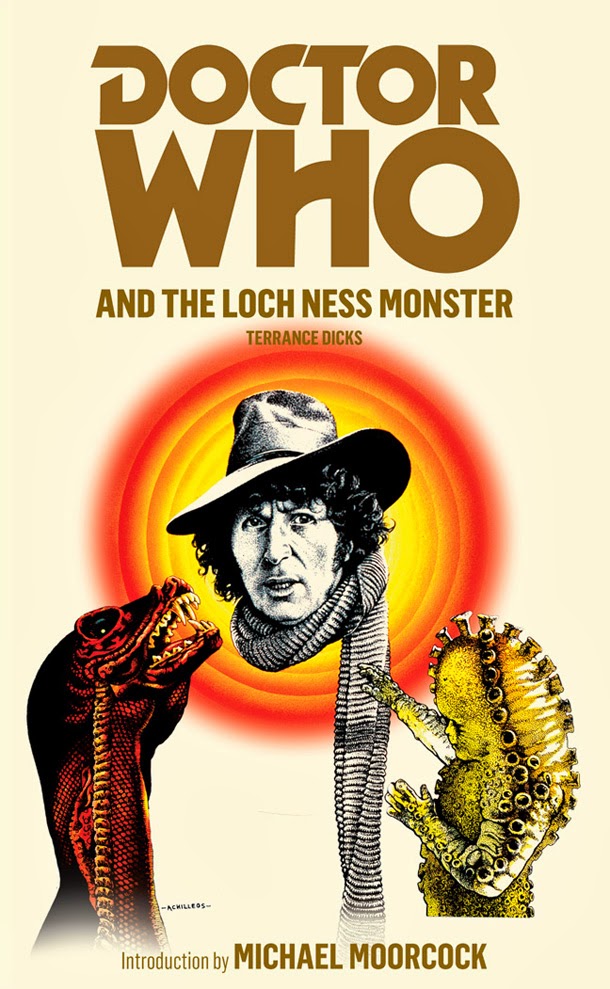
‘Doctor Who and the Loch Ness Monster’ – Terrance Dicks

Because not only do I have a few of these books still lurking on my shelves but I had a belting headache on the way into work and wasn’t quite up to tackling ‘The King in Yellow’. I’ll do that on the way home instead.
Doctor Who novelizations are almost pointless these days given that you can have a quick poke around online and just, you know, buy the DVDs. For people like me though, they will always be a reminder of the days when these books were the only way that you could catch up with Doctor Who adventures that were already years old by that point. Take ‘Doctor Who and the Loch Ness Monster’ for instance; when the last episode aired (20th September 1975) I was only four days old so there was no way that I would have ever seen it. Enter the books then, nearly all of which felt like they were written by one Terrance Dicks. The first truly prolific author in genre fiction? Not at all but it felt like it when I was five or six and just starting to go to the library.
I’ve brought more than a few Doctor Who DVDs since then but never watched ‘The Loch Ness Monster’ so, once again, I was very grateful to Terrance Dicks and his ability to seemingly pull a finished book out of thin air. You want some blurb? Well, here it is…

Centuries ago, a Zygon spaceship crash landed in Loch Ness. Now, with their home planet destroyed, the alien creatures plan to take over Earth. Their most powerful weapon is a huge armoured dinosaur-like creature of terrifying power that they brought to earth as an embryo - the Loch Ness Monster.
The Doctor, Sarah and Harry soon discover that the Zygons have another weapon. They can assume the identity of any human they capture. Who knows which of their friends might really be a Zygon?
UNIT faces one of its toughest battles as Broton, Warlord of the Zygons, puts his plan into action and the Loch Ness Monster attacks.

My commute into work is just over an hour (on a good day) and that was just enough time to polish off ‘Doctor Who and the Loch Ness Monster’; a light entertaining read that seemed to be written especially for a commute. There is nothing deep about this book at all; Dicks always seems to take the approach of ‘telling it exactly how it happened on the telly’ and that never seems to leave any room for character development or even a little more description of the background scenery. In a sense that approach is what made the Doctor Who novelizations so appealing to kids like me; the knowledge that what you were reading was exactly the same as what would have been on the TV. As a reader though, it’s hard to ignore the fact that ‘The Loch Ness Monster’ is very light on everything you would expect from a good read. There are thrills and adventure but there’s not a lot else. One thing that Dicks does do well though is capturing the essence of the main cast (again, tying it back to that whole ‘what you would have seen on TV’ approach). The Doctor has that hint of the alien about him, the Brigadier is very uptight (but resigned to the Doctors way of doing things) and Sarah Jane is resourceful and keen to do the right thing. It’s not enough to raise the overall quality of the read but does give you a feel for the characters and that’s always welcome.


‘Doctor Who and the Loch Ness Monster’ is more than likely one for people like me then, trying to re-capture memories of reading the Target novelizations as a child. That nostalgia will get through this book (and the rest) but if you don’t have that nostalgia, ‘The Loch Ness Monster’ is nothing more than a fairly enjoyable way to kill an hour’s worth of commuting.

Monday, 17 March 2014

A Couple of Warhammer 40K Short Stories…

Because sometimes you’re stuck on a packed train with no room to reach into your bag and get the book that you’ve been dying to read, ‘No Hero’ by Jonathan Wood just in case you were wondering. It’s all you can do to hold a hand out and read whatever is on your phone; Facebook and Twitter mostly but also Warhammer 40K short stories on occasion, stories like these two…


‘Truth Is My Weapon’ – Justin D. Hill

Interrogating a prisoner who calls himself Alpharius, Wodin Grime of the Inquisition begins to question everything he knows and all that he holds dear.

To be honest, I really wasn’t sure what to make of ‘Truth Is My Weapon’. On the surface it’s written solidly enough but a little too straightforward to be really engaging; it’s over before you know and I was left thinking, ‘oh, was that it?’ Let the story sink in a little bit though and the duplicitous nature of the Alpha Legion casts a whole new light on this story and lends it some real impact. Or did Justin Hill strike lucky and really did just write a solid but uninspiring tale? With the Alpha Legion you can never be sure.


‘Censure’ – Nick Kyme

In the depths of Calth’s arcology network, the Underworld War has raged for years. Aeonid Thiel, previously an honoured sergeant of the Ultramarines, once again finds himself in trouble – pitted against the daemonic forces of the Word Bearers, he has no choice but to venture back to the ravaged surface and brave the deadly solar flares that have scoured all life from this world. With a lowly Imperial Army trooper as his only companion, it falls to him to drive the maniacal Dark Apostle Kurtha Sedd and his warband from the overrun XIIIth Legion stronghold.

I loved the character of Aeonid Thiel from ‘Know No Fear’, seemingly the only Marine capable of thinking outside the box a little and therefore one of the only Marines capable of turning the tide. Thiel is up to more of the same here as his mission across the surface of a ravaged Calth makes for opportunities to get to know him better (explored through the relationship with his Imperial Guard companion) and also watch him take down the enemy in stunning moments of future warfare. There’s a nice little twist at the end as well. A welcome return for one of the Horus Heresy’s lesser known, but still very intriguing, supporting cast. If anyone fancies writing more about Aeonid Thiel then I for one would be very grateful. ‘Censure’ made for a gripping read where Calth’s sun itself is just as much the enemy as the forces of chaos wandering the planet.

Tuesday, 11 March 2014

'The Wolf of Ash and Fire' - Graham McNeill (Black Library)

As much as I moan about issues with the Horus Heresy series as a whole, it seems that I can't help but follow it. What's not to enjoy after all? Enhanced post-humans fighting each other in a civil war that will lay waste to a galactic empire; there's a lot of good stuff to be found here and certain authors can always be relied upon to come up with those goods. Graham McNeill is one of those authors, and has written some excellent Horus Heresy novels, so when I saw that Black Library were giving away a free Horus Heresy short story of his (for World Book Day) I was all over it like a rash.
It was a bit of a shame then that 'The Wolf of Ash and Fire' wasn't really that good. Is there such a thing as a bad book if it doesn't cost you anything? Well, I didn't hand over any money for 'Wolf' (that's true) but I did invest time in reading that I won't be getting back...

'The Wolf of Ash and Fire' is essentially a prelude to the prelude of the Horus Heresy series (Horus and the Emperor fight Orks on a scrap world before moving on to the main conflict on Ullanor). There's no real sense of connection to the larger narrative then, just a lot of fighting that is eye-catching to begin with but tails off into nothing when you realise that there is no real plot to hang it off. Orks die and then we are promised that more Orks will die in a story that hasn’t been written yet (if it ever does). A bit anti-climactic really. Actually, more than 'a bit', much more.

‘The Wolf of Ash and Fire’ works as an introduction to what the universe of Warhammer 40K is all about (hence it being free I guess) but it doesn’t actually work as a story because a key component (the plot, people!) is missing. It’s more of an advert really and I guess that’s fine if you’re happy with that, I wasn’t. As far as I know, ‘The Wolf of Ash and Fire’ is still a free download if you want to give it a go yourself.

Wednesday, 5 March 2014

‘Home’ – Poul Anderson

Is home where the hearth is or where government spending allocates it?

Yep, it’s time for another short story from Poul Anderson’s ‘The Queen of Air and Darkness’ collection. I’m not one for ‘full on’ reading resolutions this year but I do want to read older fiction as well as stuff that I wouldn’t normally pick up. ‘Home’ fulfils both of these criteria being a science fiction tale first published in 1966 (‘Orbit’ magazine, originally called ‘The Disinherited’) so here we go…

What happens when it becomes economically unfeasible to explore and colonise space? When there’s no money left, you really need to focus on what you have and make that work instead; that’s the concept underpinning ‘Home’ where Earth authorities have decided that the age of exploration is done (there’s nothing much out there anyway) and it’s time to bring everyone home. And that was the first thing that got me about this story; if resources are that stretched then why bring people home at all? More mouths to feed and all that, why not leave them out there? Especially if they’re actually happy where they are in the first place.

And that’s the real focus of this tale, what does ‘home’ mean when you’re making it on another planet entirely? Does anyone have that right? Obvious parallels are drawn with what happened to the American Indians; a little too obvious for me and a line that detracted from further exploration into the character of Yazkov Khan, the man sent to bring the scientific expedition (more like colonists now) home. Here’s a man whose job has essentially made him homeless and obeys the orders of the Earth Directorate even though he violently disagrees with their new mandate. There’s real conflict here but it’s only really hinted at in the final paragraph and that’s a bit of a shame. Khan is a really interesting character and deeper exploration of this could have lent ‘Home’ a lot more impact than it had (although, in fairness, I wasn’t expecting ‘Home’ to end the way it did, not at all).

What Anderson does do well is paint a picture of an idyllic existence that no-one would want to leave; a planet where the natives only real aspiration is to enjoy life, an aspiration that the human colonists are only just starting to understand and aspire to themselves. In that context then, the reader has to wonder whether the colonists are being brought home because of financial constraints or so that this Directorate doesn’t have to stretch quite so far in order to consolidate its power… Sinister undertones to a downbeat ending then.
‘Home’ gives its readers much to consider then and I certainly don’t regret the time spent reading it. I just couldn’t help but wonder if a little extra time spent fleshing out Khan, as a character, would have made this story even more thought provoking than it already is. Writing for magazines inevitably means word count but still, just a thought…

Tuesday, 25 February 2014

'Dr Bloodmoney' - Philip K. Dick

I used to have an old 'Sci-Fi Masterworks' copy of 'Dr Bloodmoney' but it vanished during one of the periodic book purges that I have. That's the way I roll and a couple of years later, without fail, I will always realise that I made a mistake. I found this copy at the Nine Worlds convention, last year, and I actually prefer it to the edition that I used to have. I know it's the same book but hear me out :o)
I love old books, possibly due to my getting a bit older myself and also because I like the idea of being a little part of a books history. This edition of 'Dr Bloodmoney' is ten years older than me and I reckon it will still be going long after I stop. There's also an innocent charm about a book that has a picture of a flying foetus on the front cover. I mean, you wouldn't get that nowadays would you? It makes me feel a little bit nostalgic in a strange kind of way. Not that I ever lived in a time of flying foetus' but you know what I mean, I hope :o) Enough of that though, here's the blurb.

Seven years after the day of the bombs, Point Reyes was luckier than most places. Its people were reasonably normal - except for the girl with her twin brother growing inside her, and talking to her. Their barter economy was working. Their resident genius could fix almost anything that broke down. But they didn't know they were harbouring the one man who almost everyone left alive wanted killed...

‘Dr Bloodmoney’ isn’t the book that you think it is. Well, it wasn’t the book that I thought it would be; about a society trying to rebuild after a nuclear holocaust. For a start, there isn’t really an awful lot to rebuild once you get out of the cities; people are finding it hard but are getting along rather nicely actually. Is this what they call a cosy catastrophe? Could be… In any case, society in many ways seems to be better off than it was before the war.
‘Dr Bloodmoney’ is more of a book about people and how they react when they realise that it will actually take more than a nuclear war to help them resolve whatever they had going on before it started. There are some exceptions like Hoppy Harrington who finds that he is now in a position where he can affect great change, both in his life and in others, but mostly it’s the same people trying to sort out the same problems they’ve always had. It’s a novel about the therapeutic process and how, ultimately, it’s up to you to sort your own stuff out if you want to move on. Dick really goes into some depth with his characters in this respect and works through their problems in such a way that we’re fully aware of just what is going on.

‘Dr Bloodmoney’ isn’t just a novel about therapy either. It’s a book that really makes you question the world that the book takes place in and the abilities of the people living there. Is Dr Bluthgeld ill or did he really start the bombs falling with the power of his mind? Was Hoppy bitter anyway or did the world make him so? Dick leaves a lot of things unanswered and he makes them questions that stick with the reader (well, this reader) for a long time after putting the book down. It’s a book that makes you question the nature of this reality; don’t be surprised if you don’t have any answers at the end of it, just the same questions.

I wasn’t so keen on the anti-climactic ending (which happens off screen and then is explained away) but, on the whole, ‘Dr Bloodmoney’ is a very intelligent and thought provoking piece of science fiction that I would say deserves to be included in the ‘Masterworks’ series. I haven’t said all that I want to say about it but had the feeling that if I kept putting this review off then it would never be written (there’s so much to say and consider in these pages).
I think there’s a new ‘Sci-Fi Masterworks’ edition that has been released, do yourself a favour and grab a copy.

Saturday, 22 February 2014

‘Doctor Who: The Curse of Fenric’ – Ian Briggs (Target)

I told you that some of the books here would be a little different from what I used to cover over at the other blog, didn’t I? I think there’s a real urge sometimes to concentrate on the ever moving conveyor belt of brand new books, headed our way, and I don’t blame anyone for doing that. I mean, look at all the cool books! Of course we’re going to want to read as much of that as we can. Inevitably though, it comes at the expense of all those old favourites (classics or otherwise) that you always mean to go back and read but forget to because, you know, new books and all that.
I’ve got a room stacked so full of books that it would be a crime to leave them all unread in favour of the new stuff and so this blog is going to be a healthy mix of old and new books. Well, that’s the plan anyway; we’ll see how I’ve done at the end of the year.

I grew up on the ‘Doctor Who’ Target novelisations; there was a library bus that came round every week (or something like that) and I used it to read as many of the books as I could. You can’t blame me really, there was no other way I was going to be able to catch up on all the adventures of the Doctor (in the days of ‘no DVDs’ etc) and there were so many even then. Those books were a massive part of my childhood and although most of them wouldn’t hold up to a determined read these days, I owe them a lot and have real fond memories of them.
Having said all that, I never read ‘The Curse of Fenric’ as a kid, it was the TV show that scared the life out of me and had me cowering in bed (but that’s a story already mentioned on the old blog…) I bought myself a copy of the novelisation, after reviewing the DVD back in July 2012, and promptly forgot about it because… new books :o)
Until now that is. I’ve been trying to mix up my reading a little bit, just recently, and this is where I ended up… Blurb shamelessly copy and pasted from the old blog because I’m tired and fancy cutting a little corner…

The Doctor and Ace find themselves at a secret military base, during the Second World War, where elements of the British army are about to lure their Russian allies into a deadly trap. A far deadlier trap is about to be sprung though as an ancient evil stirs beneath the waters of the bay and an old Viking Curse comes to fruition. Only those with faith will survive and, even then, they may not have much left afterwards…

What’s great about the old Doctor Who novelisations is that the reason they’re so good for catching up, with old stories, because they stick so faithfully to what happened on the show. You could see it playing out in your mind just as you would have done on the screen; just like the 70’s or 80’s version of a DVD ;o) They didn’t make for particularly challenging reading then but that wasn’t really the point. They were there so kids like me could read about adventures the Doctor had on TV before we were even born (and that’s pretty damn cool isn’t it?)
‘The Curse of Fenric’ really stands out from the pack by bucking that trend; I don’t think I’ve seen a Doctor Who novelisation like it in fact. It looks like all the stuff Ian Briggs wanted to do with the story on television made it into the book instead and the end result is a book with a lot more depth than you would expect to find in one of these novelisations. A shared history between Judson and Millington makes a lot of the stuff that happens on screen, with these two, suddenly make a lot more sense. Other characters get similar treatment (I would never have guessed who the double agent was or even that there was a double agent in the book…) and the end result is an extra layer of meaning that sits very well with the standard ‘tell it how it is’ approach that is going on at the same time.

What I really liked though was the mention of the game of chess that the Doctor played with Fenric; not just a mention actually, a full blown account of the game as told in ‘Ancient Arabian Tales’ translated by one William Judson. There’s an epic feel to the Doctor’s life now and Briggs does very well to tie up all sorts of plotlines that occur over centuries. That’s Steven Erikson territory and Briggs shows here that he’s more than capable of the same kind of thing.

Like I said earlier, the overall effect of ‘The Curse of Fenric’ is a really positive one and I’d mark it as one of the better Doctor Who books that I’ve read. I can’t get away from the feeling though that you would have to be a real fan of the show to enjoy this book and that’s weird because there’s nothing in the book to suggest this (other than that it’s Doctor Who and people either love it or are completely indifferent about the whole thing). I’ll have to get back to you on that one.

Monday, 17 February 2014

'Alien: Out of the Shadows' - Tim Lebbon (Titan Books)

I know this is something that just isn’t said but I’ve always found the ‘Alien’ films to be a bit hit and miss and in completely the opposite way to everyone else. There, I said it.
I’m not going to deny that ‘Aliens’ is utterly awesome and probably the best film in the franchise but ‘Alien’…? I’m sorry but I just wasn’t scared at all. ‘Alien 3’ is pretty cool though and I don’t care what you say ;o) I’m thinking about the bit where you get to see through the alien’s eyes as it chases the convicts through the tunnels; I could watch that all day. ‘Alien Resurrection’ though? Ok, that is pretty awful… I guess what I’m saying is that if they tacked on some ‘Alien 3’ bits onto ‘Aliens’ and got rid of the other films I would probably be quite happy with that :o)

As far as the books go, I’ve read a couple (have a look on the old blog for the reviews) but wasn’t all that fussed if I recall correctly. When I saw that Tim Lebbon was writing an ‘Alien’ sequel though I was definitely up for a read as Lebbon is an author whose books have always gone down well with me in the past. I say ‘sequel’… What do you call a book that is the sequel to one film but a prequel to another? I have no idea so any suggestions would be greatly appreciated!
But onto the book itself. It’s a Monday afternoon so have some cut n’ pasted blurb…

As a child, Chris Hooper dreamed of monsters. But in deep space, he found only darkness and isolation. The on planet LV178, he and his fellow miners discovered a storm-scoured, sand-blasted hell - and trimonite, the hardest material known to man.

When a shuttle crashes into the mining ship Marion, the miners learn that there was more than trimonite deep in the caverns. There was evil, hibernating-and waiting for suitable prey.

Hoop and his associates uncover a nest of Xenomorphs and hell takes on a new meaning. Quickly they discover that their only hope lies with the unlikeliest of saviors...Ellen Ripley, the last human survivor of the salvage ship Nostromo.

‘Out of the Shadows’ has a lot going for it and I read it through to the end just to see how Lebbon tied things up. There’s a lot of interesting stuff coming out of the first film that finds its way into the book and I think Lebbon does an amazing job of coming up with a book that you could read in between ‘Alien’ and ‘Aliens’ and not notice the joins. He has it all covered and what we get is a fascinating picture of Ripley in between films, someone who is just about to find the strength that she will need to carry her through what is to come; a broken woman who is only just getting her head around the Alien and what it means to her.
The addition of Chris Hooper and his crew makes ‘Out of the Shadows’ a story that isn’t just about Ripley and I liked that move in terms of how it not only fleshes out the setting but gives us a whole new cast to root for in the face of an old threat. Lebbon clearly isn’t afraid to let his characters die and this makes for some tense and visceral moments as people you’ve got to know are suddenly taken in a flurry of teeth and claws.

It’s a bit of a shame though that these moments feel few and far between. Both the ship and the mining installation, on the planet below, are absolutely massive and Lebbon is playing with a very small cast of humans and aliens so there are long periods where the narrative builds up an air of tension that cannot be sustained long enough for the payoff to be reached. There’s just too many corridors to get through first. When the payoff does come it is merciless but Lebbon makes you wait for it just a little bit too long.

‘Out of the Shadows’ is a good read but one that suffers from a backdrop that is just too big for the plot to fit comfortably in (I think I’ve said this about Lebbon’s work before…) Fans of the franchise will get a lot out of the book and it has done enough that I will more than likely stick around to see where things go in the next story. I might even have to dig out my copy of ‘Aliens’ tonight…

Thursday, 6 February 2014

'Star Wars: Honour Among Thieves' - James S.A. Corey (Del Rey)

When the Empire threatens the galaxy’s new hope, will Han, Luke, and Leia become its last chance?

When the mission is to extract a high-level rebel spy from the very heart of the Empire, Leia Organa knows the best man for the job is Han Solo—something the princess and the smuggler can finally agree on. After all, for a guy who broke into an Imperial cell block and helped destroy the Death Star, the assignment sounds simple enough.

But when Han locates the brash rebel agent, Scarlet Hark, she’s determined to stay behind enemy lines. A pirate plans to sell a cache of stolen secrets that the Empire would destroy entire worlds to protect—including the planet where Leia is currently meeting with rebel sympathizers. Scarlet wants to track down the thief and steal the bounty herself, and Han has no choice but to go along if he’s to keep everyone involved from getting themselves killed. From teeming city streets to a lethal jungle to a trap-filled alien temple, Han, Chewbacca, Leia, and their daring new comrade confront one ambush, double cross, and firestorm after another as they try to keep crucial intel out of Imperial hands.

But even with the crack support of Luke Skywalker’s x-wing squadron, the Alliance heroes may be hopelessly outgunned in their final battle for the highest of stakes: the power to liberate the galaxy from tyranny or ensure the Empire’s reign of darkness forever.

So much for me saying that I wouldn’t be reading any more Star Wars books now that the licencing is headed Marvel’s way. More and more these days, my reading is about revisiting old friends and friends don’t get any older than Han, Leia and Luke (and the rest). More than that though, ‘Honour Among Thieves’ is James S.A. Corey’s first foray into the Star Wars universe (nice timing there…) and, given how he nails Space Opera in the ‘Expanse’ series, I really wanted to be in at the start to see what he made of this very established setting. The answer is ‘quite a lot as it happens’. Corey falls foul of some familiar pitfalls (that have taken other Star Wars authors) but ‘Honour Among Thieves’ is still a lot of fun and well worth the read.

I’ve said all this before but this is a new blog so I think I can get away with saying it one more time here… ;o) The Star Wars books are hamstrung every time by the fact that certain characters are not allowed to die, especially if (in the case of this book) events are being recounted that come in between films. And that’s the other thing, we know how things are going to turn out and that kind of renders the whole book pointless really. ‘Honour Among Thieves' suffers from this just as much as you would expect. To be fair to Corey, he tries his hardest to please with a super weapon that beats all others (seriously) and loads of set piece moments designed to thrill. They almost do but, with the book being set so early on in the series (between 'A New Hope' and 'The Empire Strikes Back') there are no real surprises at all. You know that everyone will be just fine and they are. Job done, we can all go home now. I know some people say that this is the whole point and I agree with them but only up to a point. I think books need to have a little more than that if they are truly going to engage.

But I did say that 'Honour Among Thieves' was a lot of fun despite all that and it really is. Corey does an amazing job of not only digging into the seamy underbelly of the Star Wars universe but then tying it all into Solo's constantly questioning himself about his role in the Rebellion. What happens when the smuggling work runs out, what does a man do next? These are the questions that lend a thoughtful air to 'Honour Among Thieves' and a side to Solo only hinted at in the films.

'Honour Among Thieves' has a lot going for it then, falling into those familiar pitfalls but engaging in different ways entirely. If there are more Star Wars books to come from James S. A. Corey then I would certainly read them (even if I know how they will end...)

Wednesday, 29 January 2014

'Betrayer' - Aaron Dembski-Bowden (Black Library)

The Shadow Crusade has begun. While the Ultramarines reel from Kor Phaeron's surprise attack on Calth, Lorgar and the rest of the Word Bearers strike deep into Ultramar. Their unlikely allies, Angron and the World Eaters, continue to ravage each new system they come across - upon the garrison planet of Armatura, this relentless savagery may finally prove to be their undoing. Worlds will burn, Legions will clash and a primarch will fall.

I love reading Black Library books and I’ve really enjoyed the Horus Heresy books in particular; well, I did but I don’t seem to be reading much of them these days… I spoke about this a little bit when I wrote about ‘The Death of Integrity’, not so long ago, but never really went into one of the aspects of the Horus Heresy series that has kind of dampened things for me. To put it bluntly, it’s too damn long.
Now, there’s a school of thought that questions why this should be a problem. If the quality is maintained (and it is, for the most part) then a series should theoretically be able to go on forever and it won’t be a big deal. For me though, the Horus Heresy series promised explosive civil war that would engulf the galaxy but has settled down into a steady amble where things are slowly being built up to a finale that might happen one day (once Black Library decide that they can’t stretch the series any further). That’s how it feels to me anyway, I’m not the kind of person who appreciates being strung along and there are loads more books out there to read. Right?
So why am I here, right now, about to embark on a post about a fairly recent Horus Heresy book? The answer is Aaron Dembski-Bowden. In all the time I’ve been reading Black Library books, Dembski-Bowden hasn’t written a bad one. If anything, he just keeps getting better and better so the prospect of a book about the World Eaters Chapter (Space Marines that I’ve heard of but never really seen) was an intriguing one to say the least…

Everything that Dembski-Bowden touches seems to turn to gold then and ‘Betrayer’ is no different. While it may be a straightforward read with no big surprises (hence this review being a touch on the short side), ‘Betrayer’ makes up for this in plenty of other ways and this results in a read all too easy to get totally immersed in. Time spent reading ‘Betrayer’ just flew by.

Whatever Legion Dembski-Bowden focuses on, he just seems to instinctively get them and this applies to his portrayal of the World Eaters; a Legion caught between loyalty to their Primarch Angron and hatred of him for what he has turned them into. A Legion then with no other direction than to do what they have always done best, fight whatever is in front of them. Dembski-Bowden imbues the World Eaters with all the raw savagery that you would expect then unleashes the inevitable results on well-meaning but ultimately doomed Ultramarines. The resulting scenes of warfare (well, carnage really…) make for awesome reading not only for the bloodshed but also for the slight feeling of tragedy that tempers the proceedings. Here is a once proud Legion that has been basically mismanaged into a pack of snarling animals that don’t even have the nobility of the Space Wolves. Angron himself is the most tragic character of all, a man forced to turn his back on everything he knew was right and take up a life of cold loneliness. It’s a sad state of affairs and Dembski-Bowden uses the sense of inevitability, which comes with it, to introduce powerful new tones to the plot as stronger minds take control and force events to their own ends. Yes, fans will know the outcome but the stops that Dembski-Bowden forces us to take along the way really make the reader appreciate what the unfolding events mean for everyone involved. From Primarchs and Marines at the centre of the Heresy to the humans caught in their wake and forced to readjust their entire lives; Demsbki-Bowden more than any other Black Library author paints the Heresy as the galaxy wide phenomenon that it is. If only the rest of the series had followed his approach, things would actually get done in this series…

‘Betrayer’ is a book that forces the reader to examine that very concept at all levels and really appreciate how all that betrayal has resulted in civil war. Everyone is guilty and everyone must reap the consequences. I can’t think of anyone better than Aaron Dembski-Bowden to bring these concepts into the Warhammer 40K universe; a writer brave enough to write stirring battle scenes whilst having his warriors mock the ability of people to capture these moments on the page. I love that attitude and I hope to see a lot more of it in this series. 'Betrayer' might take a straightforward route from A to B but what you find along the way makes that journey a little tougher than you expected.